
Fondeol
Fondeol2
Fondeol2 – Feasibility Study for Remote Monitoring of an Offshore Wind Farm
Introduction :
An offshore wind farm is generally designed for a nominal service life of 20 years. To preserve the integrity of the wind turbines, appropriate inspection and maintenance must be carried out periodically. This applies to the entire wind farm, including submerged electrical distribution cables. The design of a wind farm monitoring system, and more specifically the monitoring of wind turbine foundation structures, must take into account the wide range of components and elements that need to be monitored.
Objectives :
Structural Health Monitoring (SHM) uses damage identification techniques to monitor the condition and performance of structures in civil engineering, mechanical engineering, and aerospace applications. The objective is to improve infrastructure maintenance, particularly for offshore wind turbines, where structures are widely dispersed and access for maintenance personnel is considerably more difficult than onshore. The challenge is therefore to replace systematic maintenance inspections with condition-based maintenance, triggered when necessary based on remote structural monitoring.
Common Defects and Inspection Methods for Steel Structures (State-of-the-Art Review):
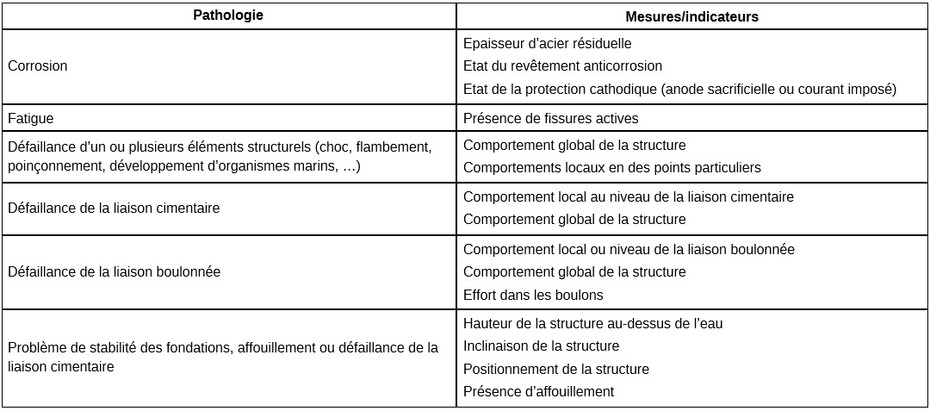
The definition of the measurement chain follows the document identifying the various standard inspection points for steel structures that can be adapted to jacket-type structures. These elements are based on a state-of-the-art review of potential structural defects and include:
Maintenance, inspection, and monitoring operations for offshore wind turbines should, in the case under study, focus on:
Study Support
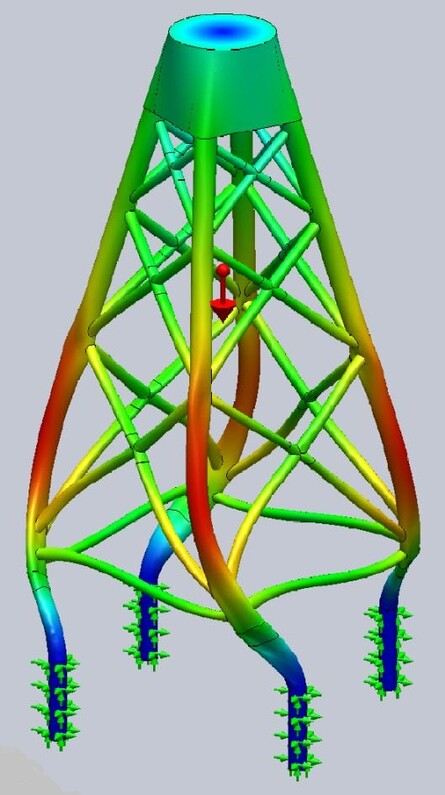
STX France, a shipbuilding company, was the French branch of STX Europe, a subsidiary of the South Korean group STX Offshore & Shipbuilding. The company was responsible for the development of the jacket-type wind turbine foundation made of welded steel tubes. Standing 45 meters above the seabed and weighing 420 tonnes, the AG1 jacket is designed to support the weight of a wind turbine throughout its service life. The study presented in this report is based on the AG1 jacket.

Modeling of Structural Defects
Prior to the numerical simulations of wind turbine foundations, a study report on structural defects in jacket-type supports was prepared (see: State-of-the-Art Review of Defects, Inspection, and Instrumentation of Jacket-Type Structures for Offshore Wind Turbine Supports). This report identifies the scenarios likely to cause damage to the foundations and characterizes them so that they can be simulated using finite element and numerical analysis software.
Comparison of Measurements with Conventional Modal Analysis
To assess the sensitivity of the structure to structural changes, a parametric study was conducted to evaluate their impact on the relative variation of the structure’s natural frequencies: STX Study of Wind Turbine Sensitivity to Environmental Conditions and Structural Defects
Study of Vibration-Based Methods under Ambient Excitation
In the absence of a wind turbine mock-up, these functions were tested on a frame structure at IFSTTAR Nantes:
Frame Structure Characteristics
The Nantes Test Frame
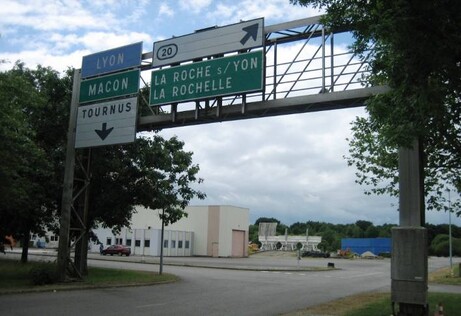
The frame is an 8 × 12 m metallic structure made of welded and machined aluminium-alloy profiles. Installed on the site for approximately thirty years, the frame is anchored to concrete foundations, with each column secured using ten threaded rods. These anchoring elements are critical to the stability of the frame.
Finite Element Model
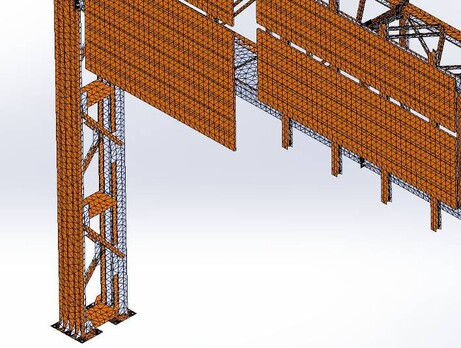
The geometric CAD model was created using SolidWorks and used to generate the finite element mesh of the structure with shell elements. Photo of the Nantes Campus Test Frame properties of the aluminium alloy are provided in the table below..
Measurement and Simulation Results
Two cases were simulated and measured:
The results show excellent correlation between the numerical simulation and the experimental measurements in terms of the relative variation of the third-mode frequency. The correlation is less significant for the first and second modes. Updating the numerical model could further improve the agreement between the simulations and the experimental results, particularly with regard to the absolute frequency values.


General Conclusion
The Fondeol2 project identified the key structural components that need to be monitored. Optimizing the monitoring instrumentation should make it possible to significantly reduce the frequency of wind turbine inspections. Vibration-based methods under ambient excitation are currently undergoing significant development for wind turbine monitoring applications. The use of software implementing these methods, particularly automated damage detection algorithms, can provide automatic alerts across the wind farm, enabling more targeted and condition-based maintenance.
Partners :