
Guided and Unguided Transport Infrastructure
Guided and Unguided Transport Infrastructure
CityVal Reference Track
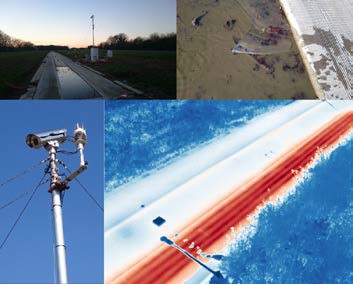
This pilot site is the focus of various research and development activities addressing energy and instrumentation issues. Equipped with a CityVal automated metro track structure developed by Siemens, the site is intended to host the next pilot demonstrators of the R5G@Nantes project, with a focus on energy-related and climate solutions.
Hybrid Solar Road (MAST-COSYS)

This project led to a COP21 demonstrator, presented by Alain Vidalies at the France Pavilion. It combines photovoltaic energy harvesting through a recycled glass layer with the recovery of heat from a fluid circulating within the road surface, thereby improving PV efficiency. An ongoing PhD thesis aims to develop a detailed model of the system and optimize its performance. More advanced alternative concepts will also be proposed. The IFSTTAR COP program includes a 50-meter hybrid solar road section as a key demonstrator.
5G for Railways

The new dynamic optical interrogator will be deployed on a section of NBT concrete railway track between Gisors and Cerqueux, with the aim of obtaining initial on-site feedback on the NBT ballastless track system. In collaboration with MAST, the NBT UHPC slab will be optimized and tested using REVE on the Sisyphe test facility. Monitoring of safety-critical railway equipment: As part of the DEMETER fixed-price project with SNCF Réseau, currently being extended into a LabCom, the objective is to make highly critical railway components connected and intelligent, including axle counters, level crossings, and point machines.
Infrastructure Safety

As part of the SIPRIS project: